
Some Skin Changes Need Medical Assessment
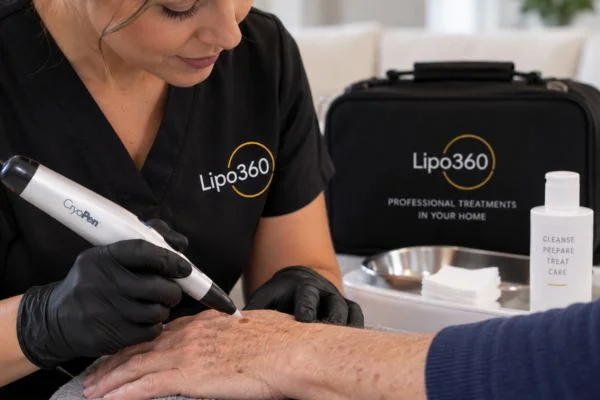
Several recognised approaches exist for managing actinic keratoses.
Depending on the individual lesion and your circumstances, a healthcare professional may recommend monitoring, prescription creams or gels, cryotherapy, surgical treatment or photodynamic therapy.
Not every actinic keratosis necessarily requires treatment.
The appropriate approach depends on factors including the number and appearance of the lesions, their location, symptoms and your individual health circumstances.
Cryotherapy for Actinic Keratoses
How Does Freezing Treatment Work?
Cryotherapy is one of the treatment approaches used by healthcare professionals for certain actinic keratoses.
It works by exposing the targeted tissue to a very low temperature, causing controlled damage to the treated cells.
Following treatment, the area may become red, swollen or blistered before crusting as it heals.
Appearance and healing responses vary from person to person.
Cryotherapy Is Not Risk-Free
Although cryotherapy is non-surgical, it is not free from potential side effects.
Possible effects can include:
Your practitioner will discuss relevant considerations with you before treatment.
Individual responses vary, and we cannot guarantee complete clearance.
This varies.
Some lesions may respond to a single treatment, while others may require further treatment or medical review.
We cannot guarantee how many sessions an individual lesion will require.
If an area does not respond as expected, returns after treatment, or develops concerning changes, seek appropriate medical advice rather than repeatedly treating the area cosmetically.
Why Medical Assessment Matters
Most actinic keratoses do not become skin cancer, but there is a small risk that some may develop into squamous cell carcinoma (SCC).
Therefore, do not assume that every rough or scaly area is harmless.
Treatment of an actinic keratosis should not be presented as a guarantee that it will prevent skin cancer.
Regularly checking your skin and seeking medical advice about new or changing lesions remains important even after treatment.
Looking After Sun-Damaged Skin
Actinic keratoses are associated with long-term UV exposure.
Protecting your skin from further sun damage is therefore important.
The NHS recommends measures including:
Sun protection cannot reverse existing damage, but it can help reduce further UV damage.
Are actinic keratoses cancer?
Actinic keratoses are areas of sun-damaged skin, not skin cancer themselves. However, some can develop into squamous cell carcinoma.
This is one reason proper diagnosis and monitoring matter.
Can Lipo 360 diagnose an actinic keratosis?
No. Lipo 360 does not diagnose actinic keratoses. If a lesion is new, undiagnosed, changing, suspicious or there is uncertainty about what it is, we will recommend assessment by your GP or another appropriate healthcare professional before cosmetic treatment is considered.
Can cryotherapy treat actinic keratoses?
Cryotherapy is one of the recognised treatments used for certain actinic keratoses.
Whether it is appropriate for you depends on the individual lesion and your circumstances.
Is cryotherapy painless?
No treatment is completely painless.
People experience treatment differently, and cryotherapy can cause cold, stinging or discomfort during treatment and tenderness afterwards.
Will CryoPen leave a scar?
We cannot guarantee scar-free treatment.
Cryotherapy can cause temporary skin changes and, in some cases, scarring or pigmentation changes.
Discuss your individual risk before treatment.
How long does the area take to heal?
Healing varies by individual and treatment area.
The treated skin may become red, swollen, blistered or crusted as it heals. Your practitioner will explain the expected aftercare for your treatment.
Can an actinic keratosis come back?
A treated area may not always clear completely, and lesions can recur. New actinic keratoses can also develop elsewhere on sun-damaged skin.
Does removing an actinic keratosis prevent skin cancer?
Treatment should not be regarded as a guarantee against skin cancer.
Continue checking your skin and seek medical advice about new, recurrent or changing lesions.
Start With An Assessment
If you have a previously diagnosed actinic keratosis and would like to discuss whether cryotherapy may be appropriate, contact the Lipo 360 team. If you have a new, undiagnosed or changing skin lesion, we recommend seeking appropriate medical assessment first.
Our team will not knowingly treat a suspicious lesion cosmetically where medical assessment is more appropriate.
ASSESSMENT FIRST
Not every skin lesion is suitable for cosmetic cryotherapy.
REALISTIC EXPECTATIONS
Results and healing responses vary between individuals.
AFTERCARE
We’ll explain how to care for the treatment area and when further medical advice may be appropriate.
References & Further Reading
